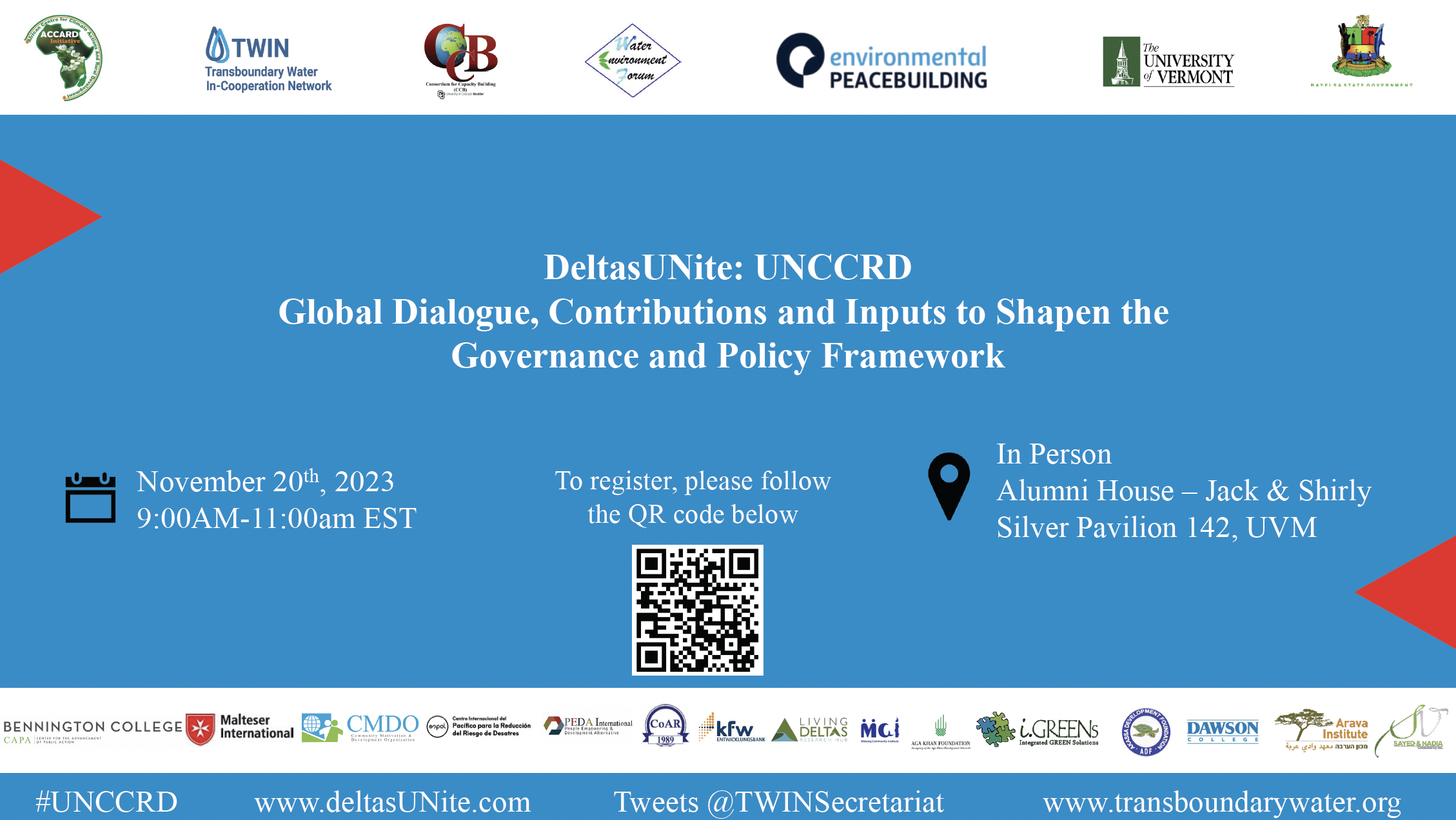
DeltasUNite: UNCCRD: Global Dialogue, Contributions, and Inputs to Shapen the Governance and Policy Framework
(Road to COP28 and Unveiling of UNCCRD)
Co-Hosted By:
African Centre for Climate Actions and Rural Development Initiative (ACCARD, Nigeria)
Transboundary Water In-Cooperation Network (TWIN Secretariat: Center for the Advancement of Public Action at Bennington College, USA; Institute for Environmental Diplomacy and Security at UVM, USA)
The Consortium for Capacity Building (CCB at UCO, Boulder, USA)
Nigeria’s Bayelsa State Government
Akassa Development Foundation
Environmental Peacebuilding Association (USA)
Co-Sponsored By:
Water Environment Forum (WEF, Pakistan)
University of Social Sciences and Humanities, VNU Hanoi, Vietnam
Arava Institute (Israel)
The Dawson College Peace Center (Canada)
Escuela Superior Politécnica del Litoral (ESPOL, Ecuador)
Community Motivation & Development Organization (CMDO)
Centre for Environment and Sustainable Livelihood Projects
Coordination of Afghan Relief (CoAR 1989, Afghanistan)
Integrated Green Solutions (iGreens, Jordan)
Go Conscious Earth (DRC, Congo)
Mekong Community Institute (MCI, Thailand)
Hybrid: Monday, November 20, 2023, 9:00 am – 11:00 am EST
Alumni House – Jack and Shirley Silver Pavilion 142
Zoom Link: https://us02web.zoom.us/meeting/register/tZErdOyqrDsqGtKeGjWn0dTG2bldNpEnvskl
#DeltasUNite
Download and share the flyer here
Concept Note & Programme
A consortium of about a dozen organizations representing both global South and North has recently coalesced and recognized by the United Nations towards setting up a new UN Convention on Conserving River Deltas (UNCCRD). As part of this global initiative, we will be organizing several hybrid events geared towards engaging diverse stakeholders, especially representatives of vulnerable communities from key river deltas and scientists involved in understanding the risks faced by global delta communities. The present event is a multi-stakeholder’s dialogue is focusing on the policy and governance perspective needed for UNCCRD operationalization, to build an integrative “highlands to oceans” approaches for conserving river deltas. Also, to well-capture and reflect on the document the participatory transboundary and global cooperation to resolve some of the associated and lingering climate induced conflicts, social and environmental challenges caused by sea level rise, saltwater intrusion and other deltas challenges.
The new convention (UNCCRD) leading to this discussion is of urgent importance owing to the increasing numbers of science documentation and news reports of the worsening climate crises. This foregoing has further underscored the urgent need for accelerated and coordinate science, social, community and international efforts, to find solutions to the cascading water resource challenges leading to human migration especially among young people, water shortage to poverty, hunger and communal conflicts as well as new disease outbreaks. The river deltas are especially the epicenters of these crises both due to loss of freshwater from highlands and rising sea levels and saltwater intrusion from oceans. The UN can facilitate an international multistakeholder platform to provide the urgently needed dialogue and transformative action, to be called “United Nations Convention on River Deltas (UNCCRD)”. This platform will provide the participation and inclusive leadership urgently needed to spontaneously address the impending future water challenges and looming global crises of food, conflict, and freshwater availability.
UNCCRD will be the game changing collaborative solution that will blend long expected indigenous knowledge with science. Also, coordinate governmental interventions across vertical and horizontal levels, as well as establish a global network of community scientists and deltas interest groups will include civil society organisations. The UNCCRD platform is aimed at resolving some of the existing and future concerns of the peaceful coexistence and conflicts in sub-Sahara Africa (SSA), South Asian and South-East Asian countries with shared trans-boundary water resources in the future. Further, it will help to mitigate the growing agitations of indigenous peoples and local communities including young people, women and elderly – mostly vulnerable to the cascading climate change impacts in our deltas globally.
Previously, and on September 22nd 2023, we organized the first global event providing for more community voices in the design of UNCCRD management policies and governance structures were from river deltas in Africa, Asia, Europe, Latin America and North America. The present is the second event will be held on November 20, 2023 to gather more inputs and suggestions from international and governance experts on the policy and governance solutions relevant to draft the UNCCRD.
Previous Concept Notes from UN 2023 Water Conference
Concept Note on the UN Water Conference (NYC)
UN 2023 Water Conference Side Event
If you are interested in participating and registering for the virtual event, please take a moment to submit your information through the link at the top of this page